Watch in your language
Why a K-drama isn't dubbed, and how to hear it in your language anyway
Seen from Lithuania on 16 November 2026, Reply 1988 on Netflix plays in Korean only, with subtitles, while When Life Gives You Tangerines has English and German dubs as well. Dubs on K-dramas vary like that from one series to the next, and one can even stop halfway through a season. Below, from Netflix's own help and its title pages: why one series has a dub in your language and another does not, how to find the ones that do, and what is left when there is none, whether for a grandmother who only understands Hindi or for anyone who follows a story better by ear than by reading.

Two K-dramas, two sets of languages
Netflix gives every title its own audio and subtitle languages. Here are two of its K-dramas as their pages on netflix.com listed them, seen from Lithuania on 16 November 2026:
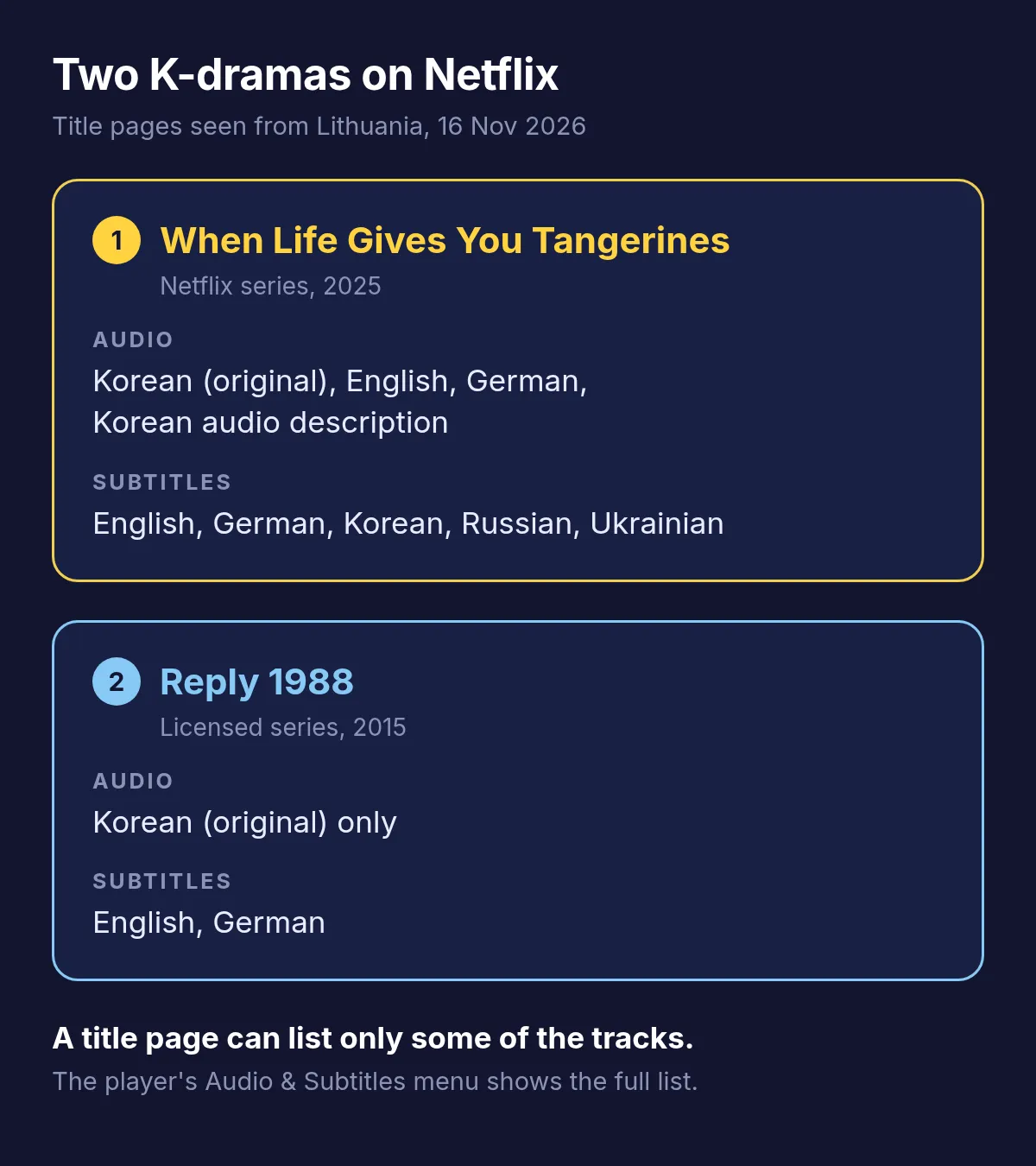
When Life Gives You Tangerines (2025) is a Netflix series, and its page lists English and German audio beside the Korean, plus a Korean audio description track. Reply 1988 first aired on Korean television in 2015 and is licensed to Netflix, and its page lists Korean audio alone.
A title page can name only some of the tracks. On a film tested in How to translate Netflix, the page named six audio tracks and the player offered 20. Where you are changes the list too. For the full list, start an episode on netflix.com and open Audio & Subtitles, the speech bubble at the bottom right of the player.
Why one K-drama has a dub and another does not
A dub is a new soundtrack: actors record every role again in another language, one recording for each language. Netflix's help names four things that decide which audio and subtitles you see: where you are, your profile's language preferences, the title, and the device. For the title, it points to content licensing and show agreements. For a K-drama, that works out like this:
- The licence. A series that Netflix licenses from a studio or broadcaster comes with the languages its agreement allows. Reply 1988 is one, with Korean audio alone.
- Where you are. Those agreements differ by country, so the same series can have a dub in one country and not in the next.
- Older seasons. Netflix's help says seasons of a series can come from different sources, and that seasons offered before 2018 may lack some languages.
Netflix does hear about the gaps. In April 2025 it said it receives thousands of requests every month for languages titles lack, and that nearly a third of all viewing on Netflix is of titles not in English, as RTÉ reported.
Many K-drama fans would not switch to a dub anyway. When someone on Reddit asked why Reply 1988 has no English dub, most replies recommended the Korean voices with subtitles. Subtitles are the more common track as well: even Tangerines, with its two dubs, lists five subtitle languages on its page.
Why a dub stops halfway through a season
Someone on Reddit who plays K-dramas while working found that one series was dubbed in English for its first six episodes and then went on in Korean with subtitles, and that on another the last three episodes had no dub. Netflix's help describes one way this happens: on a licensed show released week by week or on a rolling schedule, its language options come once the episodes are completed.
King the Land showed the same in Hindi. In July 2023, Film Companion reported that Netflix India held the series back by nearly a month, seemingly for the Hindi audio, and that only four of the twelve episodes out at the time had the Hindi dub. By its account, it was the first show dubbed while it was still airing in South Korea.
So open the audio menu in every episode, not only the first. Episodes without the dub may get it later, though Netflix gives no date for that.
How to find K-dramas dubbed in your language
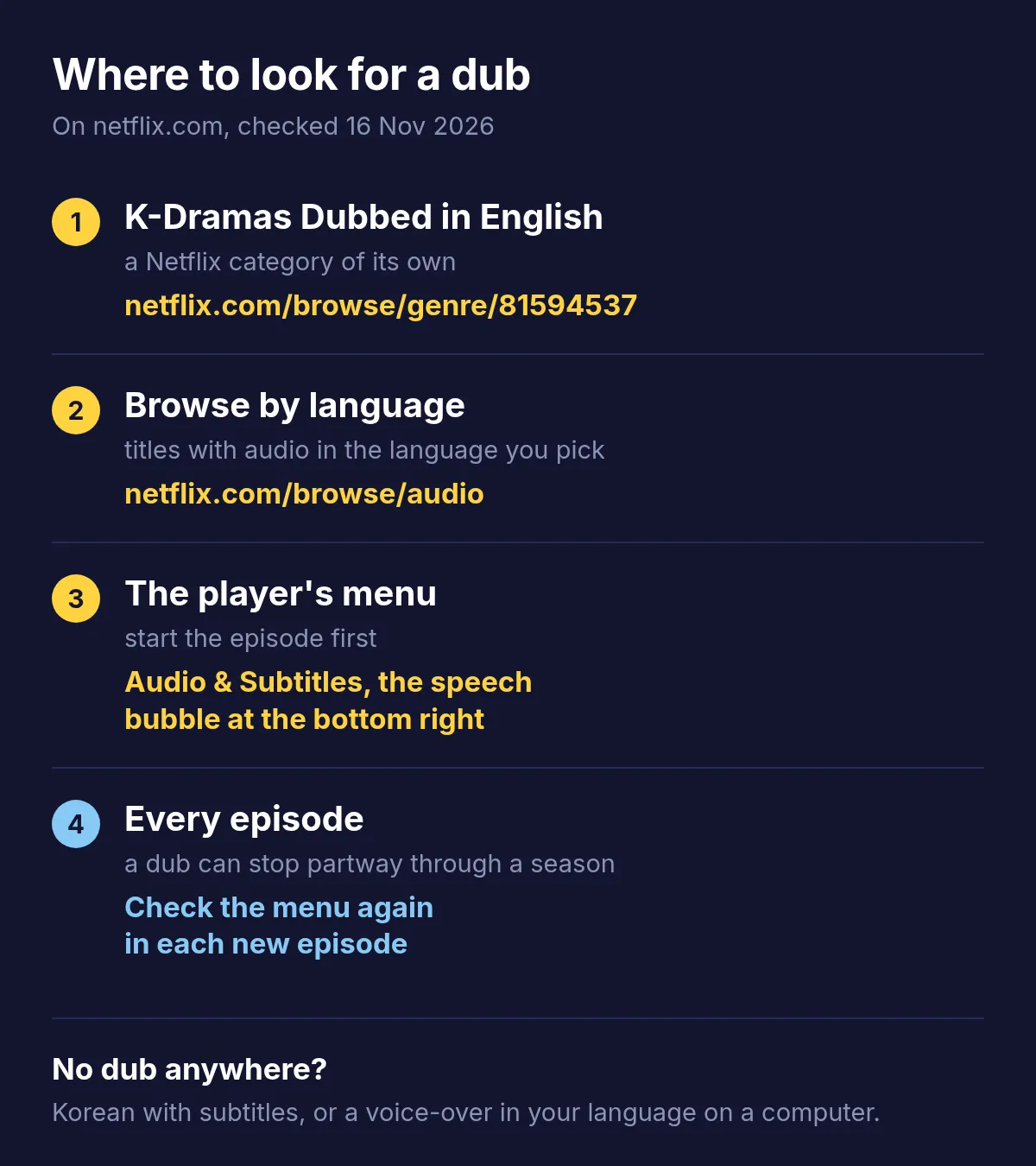
Two pages on netflix.com list dubbed titles, and the player has the final word, episode by episode:
- The category K-Dramas Dubbed in English, at netflix.com/browse/genre/81594537, collects the K-dramas with English audio.
- Browse by languages, at netflix.com/browse/audio: choose your language, Hindi for example, and the page lists the titles with audio in it where you are.
- The player: start an episode and open Audio & Subtitles, the speech bubble at the bottom right. It shows every track the episode has where you are.
- Every episode: open the same menu again when a new episode starts, since a dub can cover some episodes and not others.
When a series should have your language and the player's menu still lacks it, your profile's language settings, the device or the country Netflix thinks you are in may be hiding it: what to check when a language is missing on Netflix, in order.
Other services also set languages title by title and country by country. On Disney+, the app language and a title's audio are two separate settings: what to do when Disney+ lacks your language. On Prime Video, some titles have no English subtitles, and no English audio either.
When there is no dub in your language
Then the choice is between reading and listening:
| Option | What you get | Where it works |
|---|---|---|
| Korean audio with subtitles | The actors' own voices, with Netflix's subtitles in a language you read | Every device |
| A subtitle translator extension | Netflix's subtitles translated into your language, as text to read | A browser on a computer |
| A voice-over extension, such as Vocnu | One voice reading a translation in your language over the Korean turned down, with subtitles | Chrome, Brave or Edge on a computer |
Subtitles suit plenty of viewers, and many fans pick them on purpose. They leave some people out: a grandparent who only understands Hindi, on a series with no Hindi track where you are; someone who wants to follow a drama while cooking or working; and people who keep up better by ear. On Reddit, one viewer with an auditory processing disorder wrote that they follow a show best with English audio and English subtitles together.

Hearing a K-drama in your language with Vocnu
The Vocnu extension translates a video as it plays and has one AI voice read the translation over the original sound turned down, with subtitles in your language over the picture. It runs in Chrome, Brave and Edge on a computer, in 38 languages, Hindi and English among them. What you hear is a voice-over: one narrator reads every role, over the Korean actors.
On Netflix, Vocnu takes the subtitles in the language spoken, Korean on a K-drama, whether or not you turned them on, and translates those. An episode without Korean subtitles is heard from its sound instead: Vocnu covers the video once at the start and plays it fast while it listens, which takes a few minutes for an episode.
- Add Vocnu to Chrome, Brave or Edge from the Chrome Web Store. In the app it opens, sign in or create a free account and press Connect the extension.
- Start the episode on netflix.com, press the Vocnu button in the browser's toolbar or Alt+Shift+V, and choose your language.
- Press play. The episode holds for a while the first time, as the first lines are made.
This page has no test on a K-drama, so it gives no timings or notes on quality for one. How to translate Netflix has a full test on a film: how long the first line took, what a pause and a jump did, and how the translation came out. What holds on any title:
- One voice reads every role, over the Korean turned down. Nothing moves with the lips.
- Machine translation: a line can come out wrong, and names may be spelled by sound.
- About half a minute of waiting at the start and after a jump when the episode has Korean subtitles. Without them, the wait at the start runs to minutes.
- Songs keep their own sound. Vocnu's menu has two switches for them: Song subtitles shows the lyrics in your language, and Voice songs has them read too.
- A computer only: Vocnu does not run in Netflix's apps on a TV, phone or tablet.
What an episode and a season cost
You pay for the minutes Vocnu voices, at the rate of the grade you choose. Premium has the most natural voices and the finest translation. Standard sounds plainer, and its translation slips now and then. Economy has a plain synthetic voice and a quicker translation that slips more often. By their Netflix pages, episodes of Tangerines run about an hour, and those of Reply 1988 from 76 to 97 minutes. Each price runs from the rate of the largest credit pack to that of the smallest:
| Grade | A 1-hour episode | A 90-minute episode | Ten 1-hour episodes |
|---|---|---|---|
| Premium | 120 credits, €7.92 to €12 | 180 credits, €12 to €18 | 1,200 credits, €79 to €120 |
| Standard | 60 credits, €3.96 to €6.00 | 90 credits, €5.94 to €9.00 | 600 credits, €40 to €60 |
| Economy | 30 credits, €1.98 to €3.00 | 45 credits, €2.97 to €4.50 | 300 credits, €20 to €30 |
A new account gets 40 free credits once it confirms its email: 20 minutes of Premium voice-over, 40 of Standard or 80 of Economy, enough for a 1-hour episode in Economy. Watching the same minutes again within 90 days, in the same language, voice and mode, costs nothing. Credit packs start at €5, and their credits do not expire.