
In short
- SDH adds sound descriptions like [door slams], speaker names and song lyrics to the dialogue.
- CC began as TV’s broadcast captions; online, people often use SDH and CC for the same thing.
- An SDH file is a normal SRT or VTT. Plex and Jellyfin spot “sdh” in its name.
- Vocnu adds SDH to any upload, in the spoken language or translated, for €0.04 to €0.08 a minute more.
- In our test, Vocnu’s SDH tagged music, effects and shouts, named some speakers and caught lines its plain subtitles missed.
What SDH subtitles add
SDH is written for viewers who see the picture but can’t hear the sound, so the file carries more than the words:
- Sounds in brackets, such as [phone ringing] or [door slams].
- The speaker’s name, when the picture doesn’t show who is talking.
- Songs, with their lyrics between music notes (♪).
- Usually the film’s own language: Netflix calls SDH and CC “intralingual assets”, while plain subtitles are usually a translation.
SDH vs CC vs plain subtitles
All three show the dialogue as text. They differ in who they’re for and how they reach the screen:
| Type | What it shows | Made for | How it travels |
|---|---|---|---|
| Plain subtitles | The dialogue only | Viewers who hear but don’t know the language | A subtitle file or track, such as SRT or VTT |
| SDH | Dialogue, sounds, speakers and songs | Viewers who can’t hear the audio | A subtitle file or track, like plain subtitles |
| Closed captions (CC) | Dialogue, sounds, speakers and songs | Viewers who can’t hear the audio | Inside the TV signal; online, any caption track you turn on |
- Netflix’s partner guide calls closed captioning “a legacy term for broadcast captions in the US”, and SDH “stylistically and technically the same as subtitles” for the same viewers.
- It adds that “you may hear people using SDH and CC interchangeably.”
- “HD disc media, like Blu-ray, does not support traditional closed captioning but is compatible with SDH subtitles”, per 3Play Media, a captioning company.
One clip as plain subtitles and as SDH
On 23 November 2026 we ran a 1:50 English excerpt of Tears of Steel through the Vocnu app twice, in Standard: English subtitles with SDH, then Spanish with SDH.
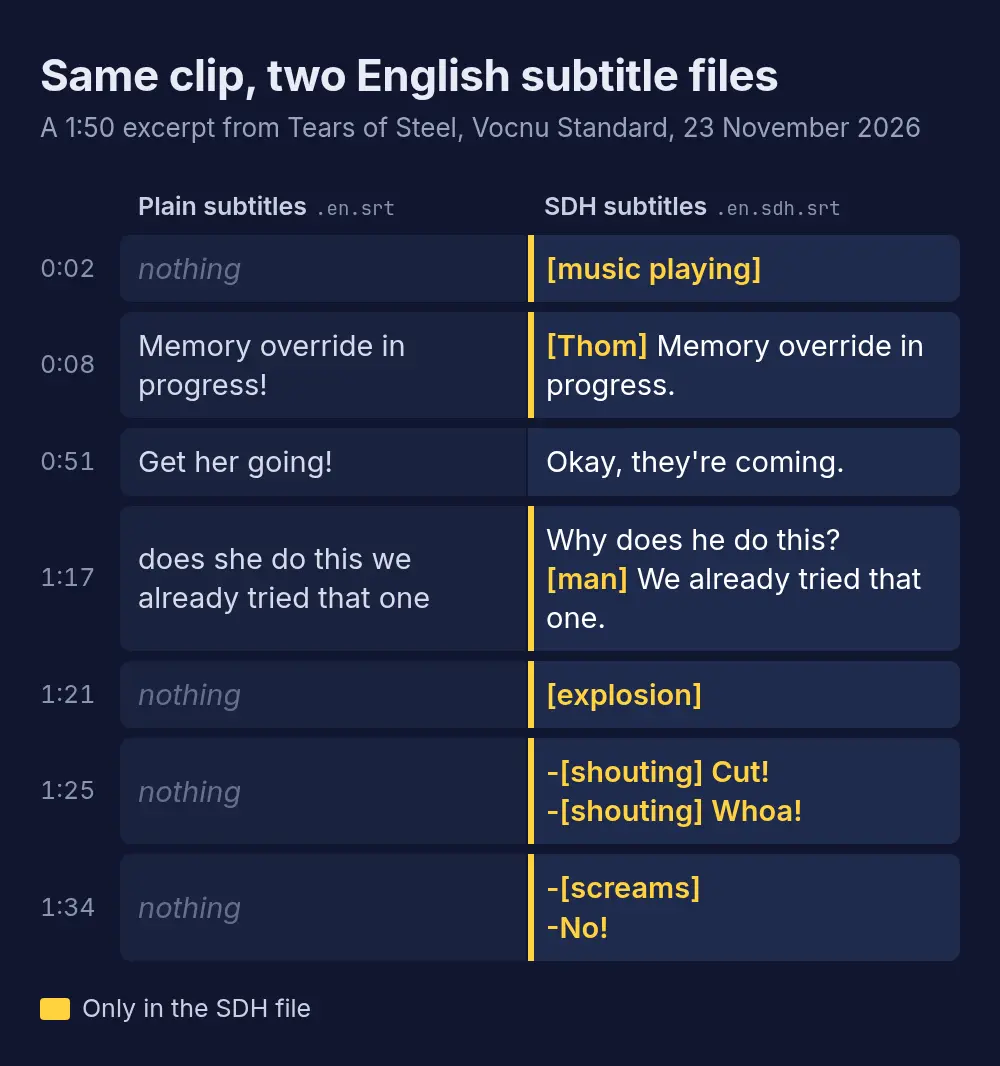
- Each job took just over a minute.
- Written apart from the plain file, the SDH came out cleaner: full sentences where the plain one ran on in lowercase.
- It kept shouts the plain file dropped, such as “Abort!” and “Cut!”, with a dash per voice in a shared line.
- It tagged music three times, effects such as [explosion] and [machinery whirring], and [shouting] on raised voices.
- It labelled the speaker on only three lines: [Thom], [Celia] and [man].
- The Spanish SDH had the same kinds of tags in Spanish, such as [Gritando], but kept the speech recognition’s mistakes from the plain Spanish subtitles: “Tom” for Thom, “¡Viva Ciccio!” for Vivacissimo, and no “Abort!” or “Cut!”.
How players find an SDH track
An SDH file is an ordinary SRT or VTT. Players tell it from plain subtitles by its name or a label:
- Plex recognizes SDH “by adding sdh or cc to the subtitle filename”, as in Avatar (2009).en.sdh.srt.
- Jellyfin marks a file as hearing impaired when its name has sdh, cc or hi, as in Film.en.sdh.srt.
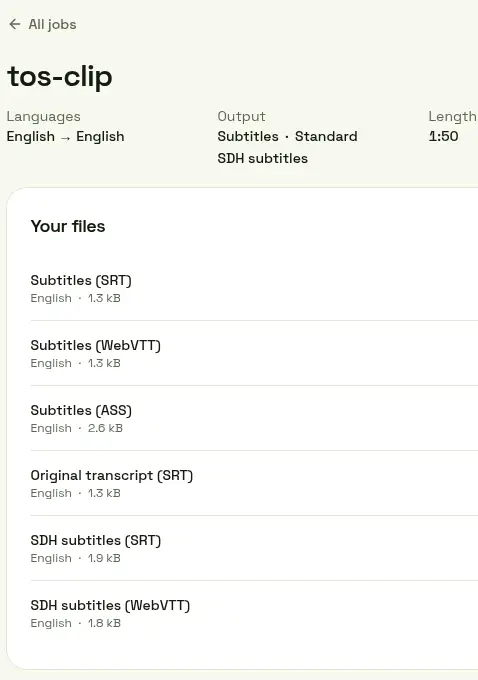
- Vocnu names its downloads the same way: our clip’s came back as tos-clip.en.sdh.srt next to tos-clip.en.srt.
- On Netflix, “look for the SDH badge on a title’s details page.” The Apple TV app labels titles CC or SDH.
Make SDH subtitles with Vocnu
SDH is a switch on the Vocnu app’s New job page, for any video you upload:
- Upload a video you own or may subtitle, up to 5 hours long.
- Pick the language it’s spoken in for same-language SDH, or another to translate it.
- Choose Subtitles or a voice-over, and turn on SDH subtitles.
- Check the price, start the job, and download the SDH file as SRT or WebVTT.
- Standard subtitles cost €0.01 to €0.02 a minute of video, and SDH adds €0.04 to €0.08.
- You see the price before the job starts, and SDH is charged only if its file arrives.
- A voice-over video also carries the SDH as a subtitle track of its own.
- A new account gets 2 h 40 min of Standard subtitles free, and plans start at €10 a month.
- It is made by AI and follows no broadcaster’s style guide. Read it before you deliver, and hire a captioner where one is required.
Publishing lessons or company training? See Vocnu for course creators and for training videos.
Questions and answers
For the viewer, nearly: both write out the dialogue, sounds and speakers. CC is the broadcast TV format, while SDH is a subtitle file, so discs and streaming services often list SDH.
SRT is a file format, and English SDH can be an SRT too. A plain English SRT has only the dialogue, while an SDH one adds sounds, speakers and songs.
Only for viewers who can’t hear the audio. Others may find the sound tags distracting, so offer SDH as a track of its own next to plain subtitles.
Yes. Apple notes SDH “might be available in additional languages”, and Vocnu makes SDH in whichever language you translate into.
Sources
- Netflix Partner Help: What is the difference between subtitles, SDH and CC?partnerhelp.netflixstudios.com (opens in a new tab)
- Netflix Help: How to use subtitles, captions, or choose audio languagehelp.netflix.com (opens in a new tab)
- Apple Support: Check if movies and TV shows have accessibility features in the Apple TV appsupport.apple.com (opens in a new tab)
- 3Play Media: SDH vs closed captions3playmedia.com (opens in a new tab)
- Plex Support: Adding local subtitles to your mediasupport.plex.tv (opens in a new tab)
- Jellyfin docs: Movies, external subtitlesjellyfin.org (opens in a new tab)
- Blender Foundation: Tears of Steel (CC BY 3.0)mango.blender.org (opens in a new tab)
Found something out of date? Write to support@vocnu.com and we will check it and correct the page.